This is an article, completely copy and pasted from a June 1, 2020 article from CNN entitled, “99 Years Ago Today, America was shaken by one of its deadliest acts of racial violence.” Written by Alicia Lee and Sara Sidner. My goal and intention is not to plagiarize whatsoever. These are not my words, except to say that I am baffled (and really appalled) as to where this was in my textbooks growing up. I love history. It was my favorite subject in school. Yet embarrassingly enough, after living three decades on this earth, today was the first time I read about such an atrocity. It really is mind-blowing and heartbreaking beyond words. Not to mention there is quite a bit of information this article does not cover, like bombs being dropped out of planes. Really, this is so much more than broken glass and hurt feelings. Please. Look up and read more on this topic, this tragedy. And before you go pointing fingers at the ways in which people are expressing their frustration, be sure to do your best to understand why they are mad.
As Americans’ rage over racial injustice boils over into a sixth day of protests, Monday also marks the 99th anniversary of one of the worst acts of racial violence the country has ever seen.
This year’s anniversary of the 1921 Tulsa race massacre comes amid nationwide demonstrations sparked by the death of George Floyd, a 46-year-old unarmed black man who died last week at the hands of a white police officer in Minneapolis, Minnesota.
And while Floyd’s name along with his repeated plea, ‘I can’t breathe,’ have been exclaimed by thousands of protesters, the victims’ names of the Tulsa race massacre have been rarely spoken as the incident went unmentioned for decades in classrooms across the state. Here’s how the massacre, also known as the Tulsa Race Riot, unfolded.
In the 1920s, the Greenwood Distrct was dubbed “Black Wall Street” as the community boasted more than 300 black-owned businesses, including two theaters, doctors, pharmacists, and even pilot who owned his own private airplane.
The success of this black community, however, caused some white people in Tulsa to become envious and angry, according to Mechelle Brown, director of programs at the Greenwood Cultural Center. They commented, ‘How dare these negroes have a grand piano in their house, and I don’t have a piano in my house,’ Brown told CNN’s Sara Sidner in 2016.
The tension reached its tipping point after an elevator incident between a 17-year-old white girl named Sarah Page and a 19-year-old black man named Dick Rowland. Page worked as an elevator operator and Rowland would use the elevator almost every day. ‘This particular day after the elevator doors closed and Sarah Page and Dick Rowland were alone in the elevator a few moments, there was a scream,’ Brown said. After the elevator doors opened, Roland ran and was later arrested. Page initially claimed that she was assaulted, Brown said. Other historic accounts say Rowland tripped leaving the elevator grabbed Page’s arm, she screamed and an onlooker went to authorities. While Page never pressed charges, authorities did, and by the end of the day the rumor was that Page had been raped.
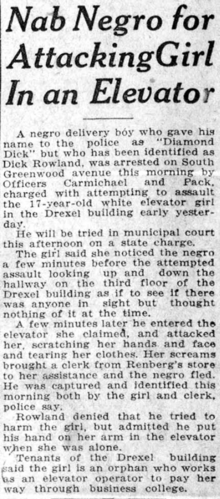
On May 31, a group of black and white men confronted each other at the courthouse where Rowland was being held. After shots were fired, all hell broke loose. Outnumbered African Americans retreated to Greenwood District, but early morning the next day, a white mob started to loot and burn businesses in Greenwood, according to the Tulsa Historical Society and Museum.
In a span of just 24 hours, 35 square blocks were burned and over 1,200 houses destroyed. Contemporary reports of deaths began at 36, but historians now believe as many as 300 people died, according to the Tulsa Historical Society and Museum.

At the end of the violence, Black Wall street had been decimated. Photos show dead African American residents lying in the streets. The scene was recreated in the first episode of the HBO series “Watchmen.”
In the decades following the 1921 massacre, it was largely unacknowledged. “Oklahoma schools did not talk about it. In fact, newspapers didn’t even riot any information about the Tulsa Race Riot,” US Senator James Lankford of Oklahoma told CNN affiliate KFOR in 2018. “It was completely ignored. It was one of those horrible events that everyone wanted to sweep under the rug and ignore.”
Oklahoma leaders announced in February that the state would move forward with embedding the story of the 1921 Tulsa Race Massacre into the curriculum of all Oklahoma schools. The city of Tulsa continues to investigate what happened to the victims’ bodies and has been digging for mass graves.
For more reading: Please visit the following–
A Report by the Oklahoma Commission to Study the Tulsa Race Riot of 1921: https://www.okhistory.org/research/forms/freport.pdf
An Eyewitness Account of the Race Riot Found in 2015: https://www.smithsonianmag.com/smithsonian-institution/long-lost-manuscript-contains-searing-eyewitness-account-tulsa-race-massacre-1921-180959251/
If you’d like to switch it up and watch a YouTube video instead: https://www.youtube.com/watch?v=x-ItsPBTFO0
And of course, the CNN link which this post came and is copied from: https://www.cnn.com/2020/06/01/us/tulsa-race-massacre-1921-99th-anniversary-trnd/index.html

